🕢Gain Liberalism and Its Discontents by Francis Fukuyama
Liberalism and Its Discontents by Francis Fukuyama
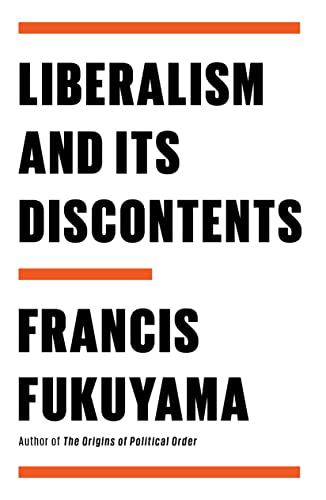
A short book about the challenges to liberalism from the right and the left by the bestselling author of The Origins of Political Order . Classical liberalism is in a state of crisis. Developed in the wake of Europe’s wars over religion and nationalism, liberalism is a system for governing diverse societies, which is grounded in fundamental principles of equality and the rule of law. It emphasizes the rights of individuals to pursue their own forms of happiness free from encroachment by government. It's no secret that liberalism didn't always live up to its own ideals. In America, many people were denied equality before the law. Who counted as full human beings worthy of universal rights was contested for centuries, and only recently has this circle expanded to include women, African Americans, LGBTQ+ people, and others. Conservatives complain that liberalism empties the common life of meaning. As the renowned political philosopher Francis Fukuyama shows in Liberalism and Its Discontents , the principles of liberalism have also, in recent decades, been pushed to new extremes by both the right and the left: neoliberals made a cult of economic freedom, and progressives focused on identity over human universality as central to their political vision. The result, Fukuyama argues, has been a fracturing of our civil society and an increasing peril to our democracy. In this short, clear account of our current political discontents, Fukuyama offers an essential defense of a revitalized liberalism for the twenty-first century. Read more
This is a joy to read. FF writes clearly and convincingly. The brevity is deceptive – he covers immense terrain, and you have to think about every paragraph. You nod along, agreeing, and when you have an objection, you find that he anticipated it and offers a fair retort. Bless him for first defining his terms. Most public debate is strawmen, false flags, and labels without meaning. “Liberalism” to FF is roughly “the West,” another misleading word, as we have managed since 1945. “The open society” is protean; it waxes and wanes in time and space. Yet it is respectful of individuals, rule-of-law based, universalist in message, and meliorist (improving) in ambition. Per FF, Liberalism has three justifications: pragmatic, economic, and moral. (This is actually a trinity, 3 sides of the same thing; what if you “did the right thing” but everybody died? This is important, for dogmatics think that way). Liberalism just works - yet people tend to hate it. At least until the Devil shows up, and then it’s quiet again for a while. CLASS!!!! FF’s method is to show how freedom’s critics begin with fair complaints, then veer into dogmatic rants that permit no facts-based correction. This is the new normal in the Internet age; all can now congregate in their own fantasy worlds of costless dogmatism. Liberalism has a built-in death wish: excess, degeneracy, cretinization. FF groks that liberalism is NOT democracy – they are in constant tension. Indeed, the modern quasi-free state is a tripod: liberalism, the administrative state, and democracy. Each is very dangerous on its own. They must balance each other. People instinctively want freedom for themselves, but not for others. Thus, as Platon warned, “democracy” degenerates into tyranny, as an angry mob elects Caligulas, turns legislatures into insane asylums, elections into vomit-fests, and at last kills the system that indulged it. The maligned administrative state (Platonic meritocracy), if strongly rooted, can check mobs run amok. (Last resort: military intervention – we got close.) Toqueville told us that democracy has a “depraved” aspect; now we can add “deranged.” The liberal live-and-let-live ethic is not intuitive to humans, it is contingent in time and space, and must be patiently inculcated over time. FF has a “pendulum” theory of history. He abhors the extremes and pleads for self-correction. He critiques both the wokist left and the “neoliberals.” (But where are they now? Is he beating a dead horse? Seems he has more trouble explaining neofascism.) Fair advocacy for groups quickly turns into “identity” politics, i.e., arbitrary factions railing against their “oppressors.” In the limit, both left and right turn into zombies speaking in tongues about “intersectionality” and “replacement” or “critical race” theory. FF respects the craving for justice, whether for individuals or groups, but warns of the end state: tyranny. Here he has ahold of a very basic phenomenon. To become popularly adopted, philosophical insights degenerate into vulgar caricatures. (Ask Jesus or Marx – and even FF must rue that he will always be Mr. History is Over.) At the end, the ideology rolls inverted and begins a new cognitive rule of terror. Modern example: Foucault’s deconstruction of language, FF says, turns lycanthrope, using language for power. You “deconstruct” ruling-class narratives to get something: power, fame, tenure, laid? Thus we wind up with Christian Haters; Marxist Ruling Classes; embryo-lovers who care not of actual children; anti-racist agitators who are in fact hyper-racists to whom nothing matters but race. A related pattern: FF exposes the tautology of dogma carried ad absurdum. First to get the evil eye: the “neoliberals” (the Hayek-Friedman line). (It’s another pejorative, favored by Europeans). Its dogma: the market is always right, and freedom is the only value regardless of results. Per FF, libertarians “hate the state” and don’t see how much they need it to protect their “rights.” Here FF caricatures the ideology, not surprisingly since the crude form does adopt such tropes. In theory, libertarians merely “hate” coercion and concentrations of power – state, economy, church, criminals. Thus, liberalism should NOT become hyperindividualistic in extremis; you can have libertarian communism, as in kibbutzim. This gets lost. Examples: The market is not “right,” it's just what happens sans dictates. GDP growth is not “good” – it tells you how fast you’re going, but not in what direction. FF comments on the free market as the social equivalent of Darwinian evolution. Just as Darwin cannot tell us which species is “right,” neither can “laissez-faire” show us which system is “correct.” Who wins must ipso facto have been the “fittest,” thus the tautology. Collectivism may prevail, or individualism - it’s all contingent. “Equality” per se is not good or bad; but systems get rigged by the powerful. We don’t have to like it just because Darwin says the fittest win. Yes, but. Take the popular strawman “Social Darwinism.” A Natural-Science perspective on social order can’t tell us what we “should” do, but it does tell us how things actually work; it cuts thru the BS. For example, FF disapprovingly quotes Public Choice Theory. But its value lies in reminding us that the public (state) actors are equally self-interested organisms at the public trough just as are corporations, the difference being that the latter don’t have an army. (Excepting “regulatory capture!”) In essence, PCT says, “Capitalism bad? Try dog-eat-dog socialism!” The same occurs in FF’s assertion that humans are not, in fact, RUMIs (rational utility-maximizing individuals) as Chicago-school economists fantasize. They have all kinds of goals and are often fooled. He correctly identifies the tautology: if all critters act in self-interest, even when seemingly altruistic (as in collective security), then the RUMI theory is useless as guidance, 0=0. Yes, but! Organisms do always act in self-interest – it is impossible not to – they are just not very good at it (we are apes!). The theory tells us what happens in fact, “was eigentlich geschah” - not what people (and their manipulators) pretend. Right or left, we must always ask, “who stands to gain from this argument?” We can see the hook: “Social justice” means “I want your stuff.” “Public safety” translates as “protect my privilege,” and so on. Then we must ask, “Does this policy actually work as intended?” Interesting section on Nationalism. FF’s compromising instinct drives him to denounce its excess, but he asserts its importance in civic engagement, as a driver of social order. This sounds like “a little hate is a good thing.” What he means is that civic virtue is essential, and maybe FF just runs afoul of his definitions. Nationalism, like its twin, religion, does many good works - just not because of it. Civic virtue is an independent variable, but frequently corrupted by these. Yes, the best way to be a good European is to be a good German, Frenchman, etc – but this means the best way to be a good citizen is to be a good citizen, wherever you are. 0=0. Segue: FF shows how “identity politics” is a resurgence of the nationalist insanity that destroyed Europe last century and spread from there. It bodes ill, but it also illustrates a very important paradox that FF does not address: People are often more free in authoritarian states than in run-away democracies. Take the polyglot Habsburg Empire. Compare with the sterile ethnic monocultures that replaced them. Take colonies: many (not all) were much freer under colonial rule. “States” are not free; people are free. Take the United States, which FF correctly calls a vetocracy, a failed democracy. Freedom also means that things actually work! This leads to a closing observation. Interestingly, FF traces liberalism not thru the Magna Carta line that Anglo-Saxons rote-learn, but to the Peace of Westfalen (1648), when Europeans gave up trying to kill each other over who loved God more. There is a subtle twist to this: that reluctant modus vivendi meant tolerance for states, not individuals. You’d still get a head shorter if you didn’t agree with your king. This continental notion survives to this day. In contrast, anarchic America was set up as a place where all were free to believe anything, and see, that’s exactly what they turned out to do! The liberal idea is largely an American one, resented both at home and abroad, but it has been so successful that most advanced nations have slowly acceded to it. FF, would liberty exist anywhere if the U.S. revolution had been suppressed? That the experiment is now off the rails is another story. FF declines to give a laundry list of reforms to defend the open society from its enemies, but identifies basic principles: individual respect, tolerance, subsidiarity (devolved power), and ends with the Hellenic ideal of moderation. Yet Cicero told us moderation in the pursuit of justice is no virtue. I think he again has a definition issue: Its not moderation we need, but realism. Realize we are just stumbling about the best we can; realize that there are no “right” answers, and every solution creates another problem; realize that all decisions are driven by cost-benefit analyses, not dogma. Thus the building of social order is a lot like a visit to the optometrist – Better – or – Worse? North Korea - or - South Korea, PRC or ROC? We see what works, and we should fix what doesn’t. Expect howling discontents; that’s liberty’s nature. FF has written more about the origins of social order than most of us can read. He struggles ever with the directionality of history, and its “end.” I think history is a giant Rorschach test: the stories we imagine in the random scatter tells us about ourselves, not about reality. It is possible that history tends to always oscillate around an equilibrium of liberty and tyranny, since the first works, and the second is parasitic. But it is equally possible that we are in the cataclysmic end stage of a runaway, unsustainable human civilization. FF could “really” be right this time: the End!
Publisher -> Farrar, Straus and Giroux (May 10, 2022) Language -> English Hardcover -> 192 pages ISBN-10 -> 0374606714 ISBN-13 -> 978-0374606718 Item Weight -> 10.7 ounces Dimensions -> 5.7 x 0.85 x 8.5 inches Best Sellers Rank: #3,041 in Books (See Top 100 in Books) #7 in Democracy (Books) #25 in Political Conservatism & Liberalism #38 in U.S. Political Science
Read Books Liberalism and Its Discontents
(Read) Books Liberalism and Its Discontents Full Access
(Download PDF Books) Liberalism and Its Discontents
*D.o.w.n.l.o.a.d eBooks Liberalism and Its Discontents /a>
*[Download] PDF Liberalism and Its Discontents Books Full Page
(Obtenir ces livres) Liberalism and Its Discontents
[Top eBook] Liberalism and Its Discontents Full Versions | Author #A#
[Shkarkoni] [PDF] Liberalism and Its Discontents


Comments
Post a Comment